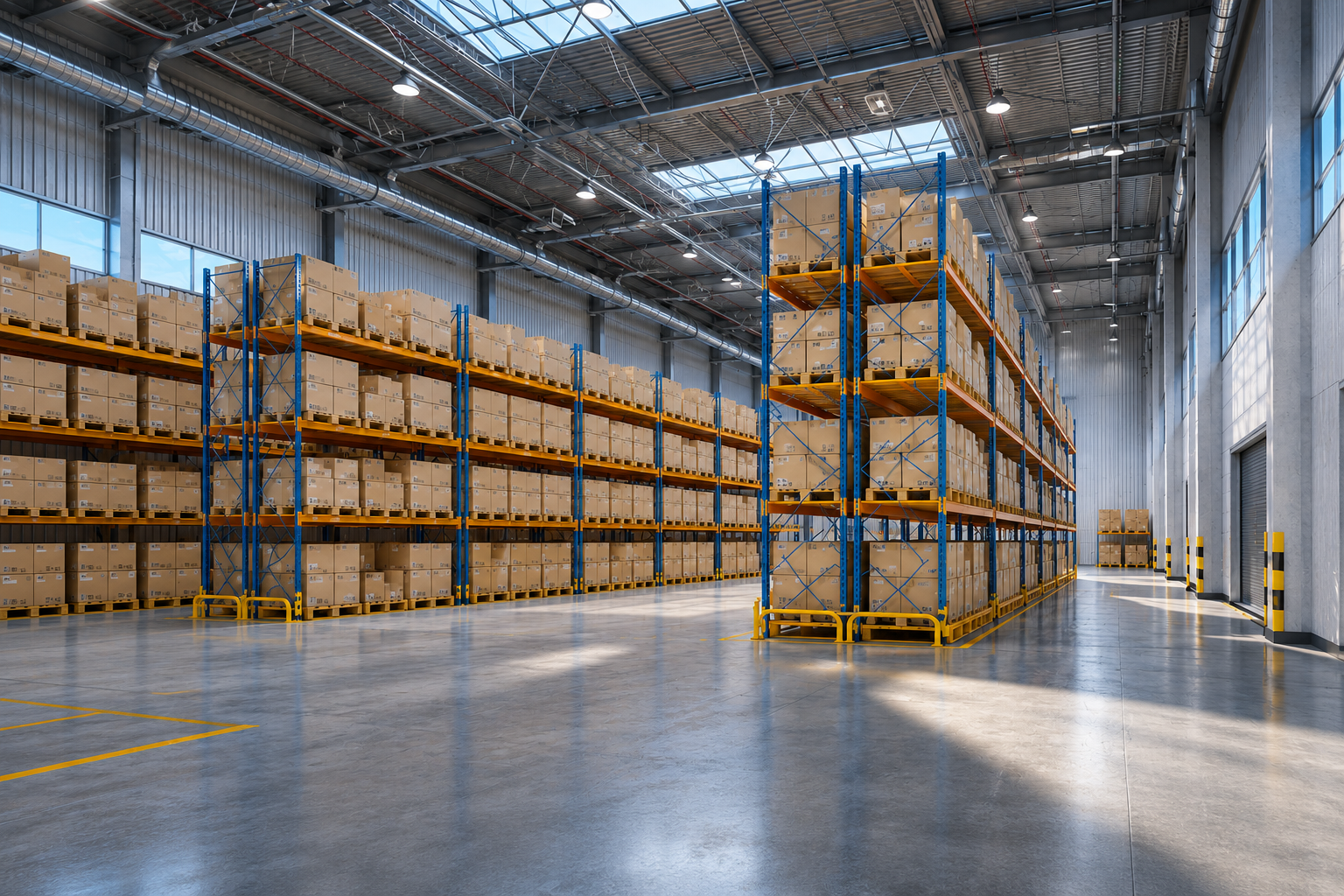

Discover how modular warehouse design enables scalability, flexible automation, and low-disruption expansion for long-term fulfillment success.

Fast, predictable delivery has become the standard, not the exception. Whether customers are ordering from an e-commerce retailer, placing B2B replenishment orders, or scheduling product distribution, they expect accuracy and speed at every stage.
But meeting these expectations requires more than isolated warehouse improvements. It demands end-to-end supply chain synchronization, the alignment of people, processes, systems, and material flow from the moment goods arrive at the dock to the moment they leave the building.
For companies struggling with rising labor costs, unpredictable order surges, and operational bottlenecks, synchronized fulfillment is proving to be one of the most powerful performance levers available.
What Is End-to-End Supply Chain Synchronization?
A synchronized supply chain ensures every upstream and downstream process works in harmony. Rather than optimizing steps in isolation (like picking or packing), leading organizations focus on unifying receiving, storage, slotting, picking, packing, sortation, and outbound workflows into one continuous, coordinated flow.
This alignment creates a warehouse environment where:
- Materials arrive when space is available
- Inventory is slotted where it can be retrieved fastest
- Picks flow smoothly into packing stations
- Shipments are staged precisely when outbound docks are ready
- Labor and automation are deployed exactly where needed
In other words, synchronization turns the warehouse from a set of departments into a single connected ecosystem.
Why Synchronization Matters: The True Cost of Disconnected Operations
The pace of change in modern fulfillment has never been faster. Order profiles shift overnight, SKU counts expand unpredictably, and growth cycles are anything but linear. Yet many warehouses remain built on rigid, fixed layouts that struggle to adapt as customer expectations evolve.
That’s why modular warehouse design has emerged as a mission-critical strategy for companies that want to stay agile, scalable, and competitive. By creating facilities that can be reconfigured quickly, without major construction or operational downtime, businesses can evolve their fulfillment networks in step with market demands.
At Tompkins Solutions, we help organizations design warehouses that are not only effective today, but engineered to scale effortlessly tomorrow.
What Is Modular Warehouse Design?
Modular warehouse design means building your facility using flexible, interchangeable components that can be rearranged, expanded, or upgraded without disrupting daily operations.
This includes modular approaches to:
- Storage systems
- Workstations and pick modules
- Conveyance and sortation lines
- Automation zones
- Mezzanines and vertical space utilization
- IT and WMS connectivity infrastructure
The goal is to create a warehouse layout where physical space, workflows, and automation all evolve together, not through a massive overhaul, but through fast, controlled adjustments.
Why Traditional Warehouse Designs Fall Short
Traditional designs focus on fixed aisles, fixed automation paths, and static process zones. While these layouts work initially, they introduce several challenges over time:
- Costly reconfiguration projects
- Long downtime when workflows must change
- Limited ability to adopt new automation
- Bottlenecks as order volumes grow
- Inefficient space use during peak seasons
- Difficulty scaling SKU variety or inventory levels
In a world where customer expectations shift quickly, these limitations create operational risk and inflated long-term costs.
Modular design eliminates these barriers by unlocking continuous adaptability.
The Benefits of Modular Warehouse Design
1. Fast Reconfiguration as Business Needs Evolve
A modular layout allows teams to shift storage density, rearrange work areas, or introduce new picking zones without tearing down infrastructure.
Examples include:
- Converting bulk storage to bin shelving in weeks, not months
- Adding a new pack-out zone during peak season
- Relocating receiving or quality control stations to reduce congestion
When demand shifts, your warehouse can shift with it.
2. Low-Disruption Path to Future Automation
Modular infrastructure makes it easy to adopt automation in phases instead of taking on a risky, all-at-once implementation.
This enables:
- AMR and AS/RS deployment in modular zones
- Scalable goods-to-person systems
- Easy connection to existing WMS and data architecture
- Trial pilots before full rollout
Instead of automation dictating the warehouse layout, the warehouse layout supports automation adoption.
3. Scalability Without Facility Overhauls
When volume increases or SKU complexity grows, modular systems allow companies to scale capacity without major construction or relocation.
This includes:
- Expanding mezzanines vertically
- Adding additional pick modules
- Increasing pack-out lines on demand
- Rebalancing workflows for peak season
A modular warehouse grows the way your business grows, incrementally, efficiently, and without major disruption.
4. Better Space Utilization and Lower Operating Costs
Because modular layouts can be reconfigured, companies achieve higher space efficiency and reduce long-term operational costs.
Benefits include:
- Less dead space
- Higher storage density
- Optimized travel paths
- Reduced congestion
- Improved material flow
Over time, this flexibility compounds into substantial savings.
5. Increased Resilience to Market Disruptions
Whether it's supply chain delays, sudden order spikes, or shifts in channel mix, modular designs make it easier to respond quickly. Operators can reassign space, reorganize workflows, or scale capacity, with minimal downtime.
In today’s disruption-heavy environment, resilience isn’t optional. It’s a competitive advantage.
How Tompkins Solutions Builds Modular, Scalable Fulfillment Networks
At Tompkins Solutions, we specialize in designing warehouses that adapt as fast as the markets they serve. Our engineering and consulting teams assess current constraints, future growth scenarios, and operational goals to create modular solutions that evolve year after year.
Our modular design process includes:
- Material flow and layout optimization
- Slotting and storage system planning
- Phased automation roadmapping
- Flexible zone design for receiving, picking, packing, and outbound
- Scalable mezzanine and vertical storage strategies
- WMS and IT infrastructure alignment
The outcome is a fulfillment network engineered for long-term scalability, minimal disruption, and maximum performance.
Modularity Is No Longer a “Nice to Have” - It’s a Fulfillment Imperative
Today’s supply chain pressures won’t slow down. Retailers, manufacturers, and 3PLs need warehouses that can respond instantly to new challenges and opportunities. Rigid, traditional designs simply can’t support that level of agility.
Modular warehouse design provides the foundation for:
- Faster response to changing customer demand
- Smoother peak season performance
- Scalable automation adoption
- Stronger resilience against disruptions
- Lower operational costs over time
In a fulfillment world defined by rapid change, modular warehouse design gives companies the agility, scalability, and operational resilience they need to stay competitive. By embracing reconfigurable layouts, phased automation, and future-ready infrastructure strategies, businesses can expand intelligently, without expensive downtime or disruptive rebuilds.
Whether you’re planning a network redesign or exploring scalable automation, modular thinking ensures every investment supports long-term growth.
To learn more about how Tompkins can help optimize and future-proof your fulfillment network, visit: https://www.tompkinsinc.com/.


About Shaun Kelly


How can we help improve your supply chain operations?
Schedule a consultation or contact Tompkins Solutions for more information.
Featured Posts
Discover valuable resources to enhance your knowledge.

.png)