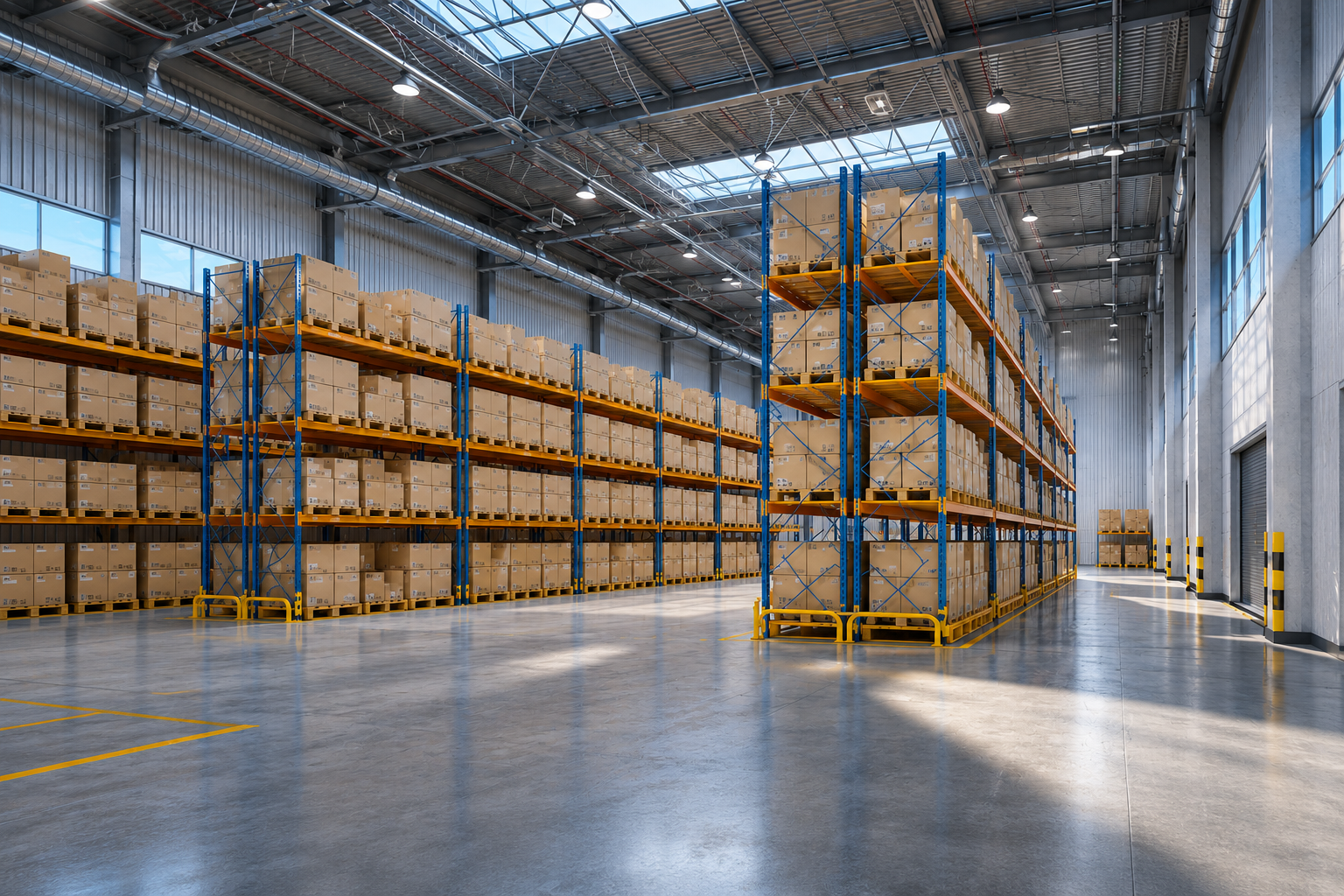

SKU proliferation isn’t slowing down. Across retail, e-commerce, grocery, healthcare, and B2B distribution, product assortments continue to expand. Customization, private labeling, seasonal offerings, omnichannel fulfillment, and long-tail e-commerce demand have dramatically increased the number of SKUs warehouses must manage.

SKU proliferation isn’t slowing down. Across retail, e-commerce, grocery, healthcare, and B2B distribution, product assortments continue to expand. Customization, private labeling, seasonal offerings, omnichannel fulfillment, and long-tail e-commerce demand have dramatically increased the number of SKUs warehouses must manage.
More SKUs create more complexity. More complexity often slows fulfillment. But it doesn’t have to.
With the right warehouse design strategy, organizations can support high SKU counts while maintaining and even improving speed, accuracy, and labor efficiency. The key is designing facilities that are built for inventory complexity from the start.
Why SKU Proliferation Creates Operational Risk
At first glance, adding more SKUs seems like a merchandising or supply chain strategy issue. But inside the warehouse, SKU proliferation impacts nearly every operational metric.
As SKU counts rise, warehouses experience:
- Increased pick path complexity
- Smaller order lines per SKU
- More slotting variability
- Higher risk of mispicks
- Congestion in forward pick areas
- Reduced storage density
Without intentional design, these pressures lead to slower order fulfillment and rising cost per order.
High SKU environments are not simply “bigger warehouses.” They are fundamentally different operating models.
The Core Challenge Balancing Variety and Velocity
Speed depends on flow. SKU proliferation introduces friction.
More SKUs mean:
- More locations to manage
- More replenishment cycles
- More decision points for pickers
- More potential bottleneck
The challenge isn’t just storing more products. It’s maintaining velocity while doing so.
Warehouses designed for limited SKU assortments often struggle when complexity increases. The result is longer travel time, inconsistent productivity, and performance that deteriorates during peak periods.
The solution lies in strategic design, not reactive expansion.
Design Principle #1: Velocity-Based Zoning
Not all SKUs move at the same speed.
High-performing warehouses segment inventory based on velocity tiers, fast, medium, and slow movers, rather than simply product category.
Fast Movers
High-velocity SKUs should be:
- Located closest to pack-out or consolidation areas
- Positioned in ergonomic, easy-to-access pick faces
- Supported by frequent, efficient replenishment
This minimizes travel time and maximizes picks per hour.
Medium Movers
Mid-velocity SKUs require:
- Balanced accessibility
- Efficient storage density
- Logical adjacency to correlated products
Slow Movers
Low-velocity SKUs can be:
- Stored in higher-density racking
- Positioned in less prime zones
- Managed with batch picking or alternative strategies
Velocity-based zoning ensures that the growing long tail of SKUs does not slow down the entire operation.
Design Principle #2: Flexible Pick Modules
High SKU environments require adaptable picking strategies.
Rigid layouts designed around one picking method, such as full-case or each-pick only, quickly become inefficient as order profiles shift.
Flexible pick modules allow operations to:
- Adjust between batch, zone, and wave-less picking
- Expand forward pick locations
- Reconfigure shelving layouts
- Adapt storage formats as SKU dimensions change
This modularity prevents the need for costly redesigns as inventory profiles evolve.
Design Principle #3: Intelligent Slotting Strategy
As SKU counts increase, slotting becomes more critical and more complex.
Effective slotting strategies consider:
- Order frequency
- SKU cube and weight
- Correlation between items ordered together
- Seasonality patterns
When slotting aligns with actual demand behavior, pick paths shorten and congestion decreases.
Without continuous slotting optimization, high SKU proliferation leads to:
- Excessive replenishment
- Misplaced high-velocity items
- Congested pick aisles
- Slower throughput
Design must accommodate slotting adjustments without disrupting workflow.
Design Principle #4: Storage Density Without Accessibility Loss
High SKU counts increase storage demand. Simply expanding square footage is rarely the most efficient solution.
Instead, warehouses must balance:
- Vertical storage utilization
- High-density storage solutions
- Accessibility for frequent picks
Design strategies may include:
- Multi-level pick modules
- Narrow aisle configurations
- Dynamic storage allocation
- Hybrid storage zones (pallet, case, and each-pick)
The goal is to maximize cubic utilization while preserving fast access to active SKUs.
Design Principle #5: Clear, Linear Material Flow
Complex inventory does not have to mean complex movement.
Even in high SKU environments, material flow should remain:
- Direct
- Logical
- Minimally intersecting
Receiving should feed storage zones efficiently. Storage should support replenishment with minimal travel. Picking should flow cleanly to packing and outbound staging.
When flow is linear and well-engineered, SKU count becomes manageable rather than overwhelming.
The Role of Automation in High SKU Warehouses
Automation can support high SKU proliferation but only when thoughtfully integrated.
Over-automation without strategic design can create rigidity. Under-automation can strain labor.
Successful high SKU facilities design infrastructure that:
- Supports phased automation adoption
- Integrates with slotting and velocity strategies
- Enhances, rather than complicates, material flow
The right balance improves throughput without locking the warehouse into inflexible systems.
Labor Efficiency in Complex Environments
High SKU proliferation increases cognitive load for workers.
Design can mitigate this through:
- Logical SKU grouping
- Clear labeling and visual management
- Reduced travel distance
- Standardized workflows
Facilities engineered for simplicity reduce training time, improve pick accuracy, and protect productivity even as SKU counts climb.
Planning for Continued SKU Growth
SKU proliferation is rarely temporary. As product assortments grow, facilities must scale accordingly.
Forward-looking warehouse design includes:
- Growth modeling to anticipate future SKU increases
- Expansion zones that preserve material flow
- Infrastructure capacity for additional storage systems
- Dock layouts capable of handling volume shifts
Designing for today’s SKU count without accounting for tomorrow’s growth leads to reactive, expensive adjustments later.
Strategic planning prevents operational strain.
Why High SKU Warehouses Require Strategic Engineering
Supporting high SKU proliferation without sacrificing speed is not a matter of adding more shelving. It requires alignment between:
- Facility layout
- Slotting strategy
- Storage density planning
- Picking methodology
- System integration
- Labor design
At Tompkins Solutions, we approach high SKU warehouse design holistically. By analyzing order profiles, inventory behavior, growth projections, and operational goals, we design facilities that absorb complexity while maintaining velocity.
The result is a warehouse that performs under pressure, not one that slows as product variety increases.
Turning Complexity Into Competitive Advantage
High SKU proliferation is often driven by customer demand for variety and personalization. Companies that can manage this complexity efficiently gain a competitive edge.
Warehouses designed for SKU flexibility achieve:
- Faster picking speeds
- Higher order accuracy
- Lower cost per order
- Improved space utilization
- Greater scalability
Instead of viewing SKU growth as a burden, these operations treat it as an opportunity.
SKU proliferation is here to stay. The organizations that thrive will be those that design warehouses intentionally around inventory complexity, not those that retrofit outdated layouts to cope with it.
Designing warehouses for high SKU environments requires foresight, engineering precision, and strategic integration.
If your facility is experiencing congestion, slowing pick rates, or rising operational costs due to SKU growth, it may be time to rethink your warehouse design strategy.
At Tompkins Solutions, we help organizations build high-performance distribution centers that manage complexity without sacrificing speed, ensuring your warehouse evolves as quickly as your product portfolio.
Learn more at: https://www.tompkinsinc.com/


About Shaun Kelly


How can we help improve your supply chain operations?
Schedule a consultation or contact Tompkins Solutions for more information.

Featured Posts
Discover valuable resources to enhance your knowledge.


.png)